
The Selection Criteria of Inria Startup Studio
We are often asked about the selection criteria for our startup studio, even though they are explained on this website, so we will take the time to elaborate on them here. The message is clear from the moment you enter the site: “An idea, a desire, and a technology? If…
We are often asked about the selection criteria for our startup studio, even though they are explained on this website, so we will take the time to elaborate on them here.
The message is clear from the moment you enter the site: “An idea, a desire, and a technology? If you have a project of a digital deeptech startup, our program gives you the opportunity to fully dedicate 100% of your time and energy for one year in the best possible conditions: salary, support, and much more!” To be eligible, you must be the leader of a digital deeptech startup project and be available to dedicate yourself 100% to it. So let’s go a little further!
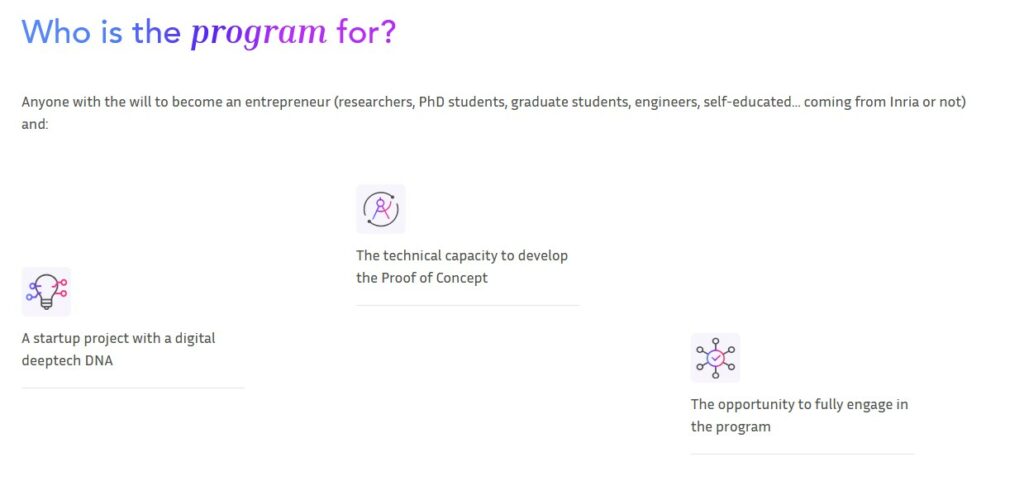
Anyone with the will to become an entrepreneur (researchers, PhD students, graduate students, engineers, self-educated… coming from Inria or not) and:
- A startup project with a digital deeptech DNA
- The technical capacity to develop the Proof of Concept
- The opportunity to fully engage in the program
The devil is in the details and each word is important.
Digital Deeptech
With digital being everywhere, as the saying goes, “software is eating the world” , it’s rare for a project not to have a digital component, but it must be deeptech. So what does deeptech mean? Wikipedia and BPIFrance can help us out a little: https://en.wikipedia.org/wiki/Deep_tech and https://www.lesdeeptech.fr/international-page/
Not entirely in our opinion, because this relatively recent term (created in 2014 by Swati Chaturvedi) as “a new category of startups which are built on tangible scientific discoveries, and which have the ability to disrupt several markets” remains ambiguous.
Let’s not delve too deeply into the idea of disrupting markets; no one is really capable of analyzing this question a priori, only a posteriori! As for tangible scientific discoveries, here too, are we talking about very recent discoveries, recent ones, or less so? And what about inventions, engineering applied to new applications? In the 70s to 90s, we spoke of “high-tech” and this included Intel, Apple, or Microsoft, and none of them would be called deeptech. In those years, only Genentech and the advent of biotechnology would have been deeptech, and besides, deeptech is first and foremost biotechnology, then everything related to physics and chemistry… so… not digital… argh, digital deeptech is a black swan! See our post-scriptum below however for a tentative definition of Deeptech.
So we must understand that the projects have a strong scientific, technical and technological component and not just the use of commodities, of well-known technologies that are easy to handle for a well-trained or experienced person.
Technical Capacity of the Project Leader or Team
We write it down and proclaim it loud and clear: it’s not so much the technology that matters, it’s the people. This should be obvious to anyone familiar with the world of deeptech startups. We won’t go back on the overemphasis on technology (see the article abotu intellectual property : www.inriastartupstudio.fr/en/intellectual-property-a-point-of-view), and we don’t underestimate it: the people we prioritize are technology leaders and experts.
Here too, the criterion has its gray areas and we try to be as objective as possible. We give priority to people who have a perfect command of the technology they wish to develop into a product. However, a product is not just a technology whose leader may not master all the components, but he or she will have to master the critical components. And there is a major nuance: we do not support leaders who could lead a technical team but rather people capable of producing a prototype or a proof of concept (PoC) and not just a vision or a concept / design. This therefore requires a certain amount of experience or know-how and not just knowledge.
Because we realize this topic is sometimes difficult to explain, let me try to expand on it. In a recent essay titled “How to Start Google,” Y Combinator co-founder Paul Graham explains that among the necessary ingredients, “You need to be good at some kind of technology.” He elaborates: “Just work on whatever interests you the most. You’ll work much harder on something you’re interested in than something you’re doing because you think you’re supposed to. […] You have to be working on your own projects, not just learning stuff in classes. […] You have to work on your own projects. You learn so much faster that way. […] If you’re wondering what counts as technology, it includes practically everything you could describe using the words “make” or “build.” So welding would count, or making clothes, or making videos. Whatever you’re most interested in. The critical distinction is whether you’re producing or just consuming. That’s the cutoff. […] You do it the same way you get good at the violin or football: practice.” It’s very difficult to assess if you are good at some technology and the advice of Paul Graham may come to late for our candidates, but ideally, we would like to select that kind of people!
A full engagement in the program
The final selection criterion is 100% availability for at least six months and ideally one year. The general rule is that we pay the technical leader for one year. The exception to this rule is that the person would be employed by another entity and made available by their employer to the project within the program (France Travail does not count among these entities). This has happened with partners such as CNRS, universities, CEA, and theoretically private companies as well.
The difficulty sometimes encountered is that a researcher or teacher wants to join the program while he or she has teaching or supervision responsibilities. We are then very bothered because a startup project requires 100% of their time, not to say 150% and not 60% or 80%. We have made exceptions but we prefer that a second person comes in to replace them, for example a post-doctoral student who will be supported by the senior researcher. We talk about “support” for the researcher and “leader” for the postdoctoral fellow in the project.
The team may be larger, there may be external leaders not employed by Inria or public entities at 100% in the project or not, “resources” – people working in the project but not decision-makers – the important thing for us is to have at least one technical leader at 100% in the project (we can employ up to 2 people per project).
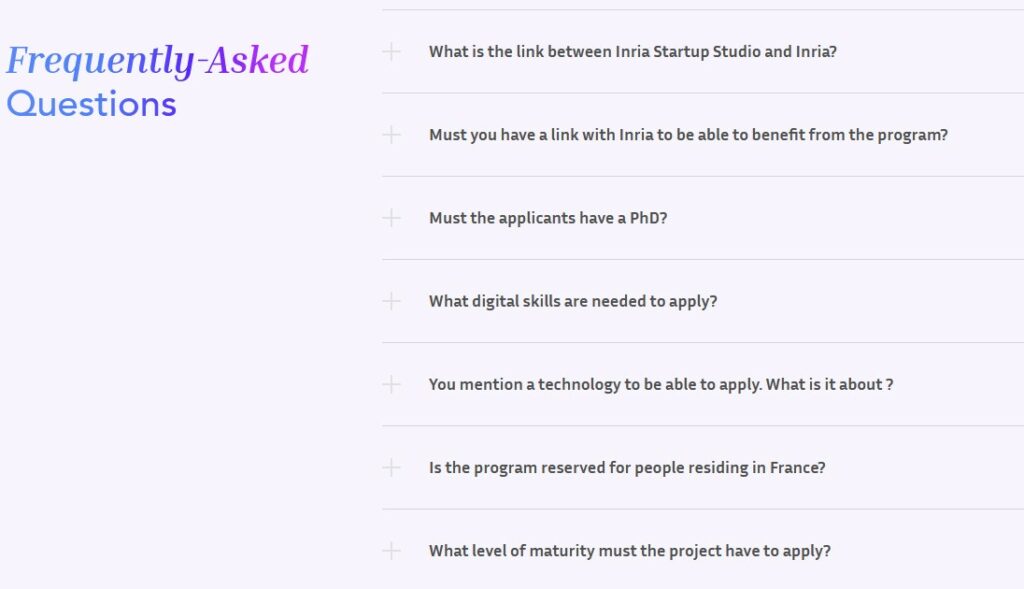
For more information, see our FAQs
This article is probably already too long, but we felt it was important to explain our criteria as clearly and simply as possible. To go further, we have a “Frequently Asked Questions (FAQ)” section on the web site.
Post-scriptum: a tentative definition of Deeptech
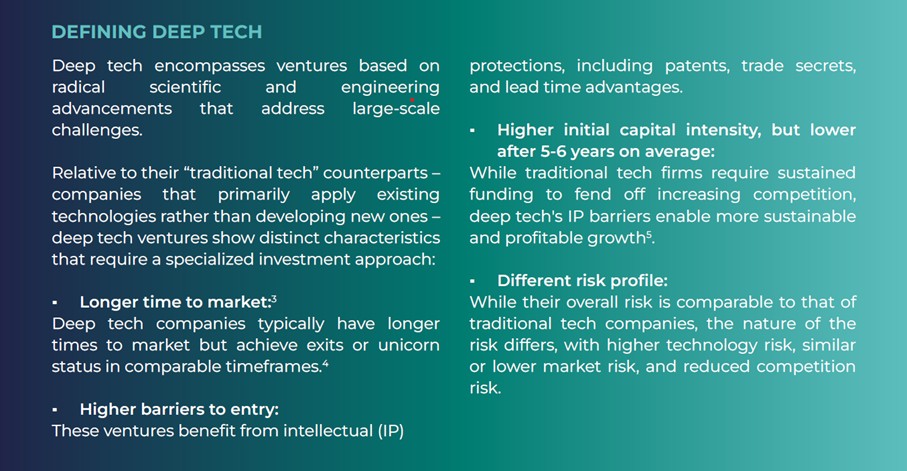
Deep tech encompasses ventures based on radical scientific and engineering advancements that address large-scale challenges.
Relative to their “traditional tech” counterparts – companies that primarily apply existing technologies rather than developing new ones – deep tech ventures show distinct characteristics that require a specialized investment approach:
▪ Longer time to market: Deep tech companies typically have longer times to market but achieve exits or unicorn status in comparable timeframes.
▪ Higher barriers to entry: These ventures benefit from intellectual (IP) protections, including patents, trade secrets, and lead time advantages.
▪ Higher initial capital intensity, but lower after 5-6 years on average: While traditional tech firms require sustained funding to fend off increasing competition, deep tech’s IP barriers enable more sustainable and profitable growth.
▪ Different risk profile: While their overall risk is comparable to that of traditional tech companies, the nature of the risk differs, with higher technology risk, similar or lower market risk, and reduced competition risk.
(From DEEP TECH DECODED: A STRATEGIC INVESTOR’S GUIDE https://hello-tomorrow.org/deep-tech-decoded/)
Publication date: 03/02/2026

Hervé Lebret
Want to get started ?